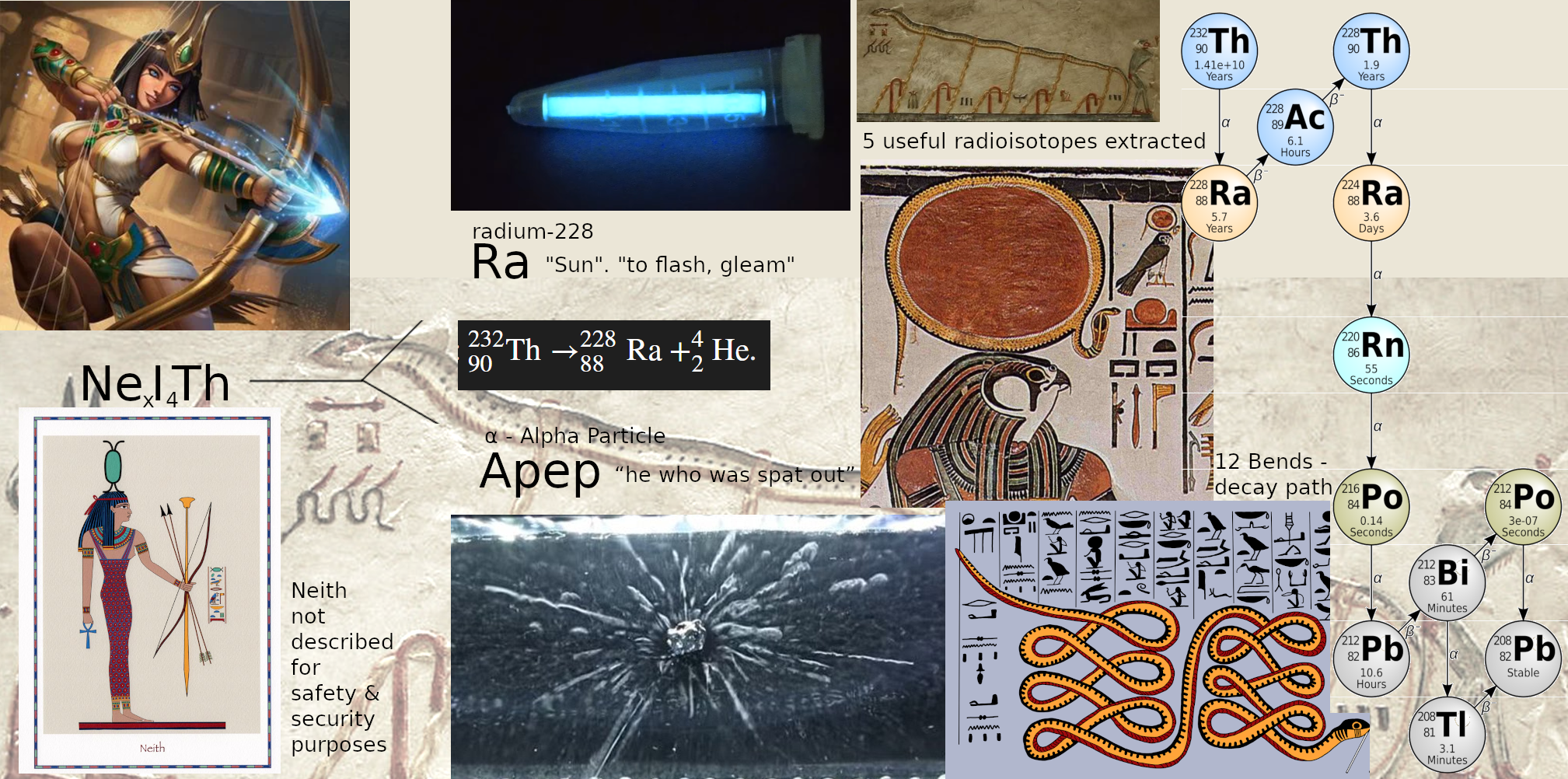
Neith (Nit, Net, Neit)
Goddess of War, Weaving, Wisdom, and Primordial Creation
Neith is one of the most ancient and complex goddesses of Egypt, predating even the creation of the world. Self-created and emerging from the primordial waters of Nun, she wove the cosmos into being with her shuttle and thread. She is simultaneously the fierce warrior goddess protecting Egypt with bow and arrows, the wise arbiter who judges disputes among the gods, and the cosmic weaver who spins fate and reality itself. Her cult center at Sais made her one of the most important deities of Lower Egypt, and her multifaceted nature—warrior and creator, mother and virgin, cosmic and domestic—makes her unique among Egyptian deities.
⚖️ Strictly Regulated
Possession, extraction, or processing of radioactive materials is illegal without specific licenses from nuclear regulatory agencies (NRC in US, equivalent worldwide).
🔬 Hazardous Chemistry
The NexI4Th compound and extraction processes involve toxic rare earth elements, corrosive iodine compounds, and dangerous chemical reactions.
🏛️ Environmental Hazard
Radiochemical contamination persists for thousands to millions of years. Improper handling creates permanent environmental damage and threatens public health.
🚫 DO NOT ATTEMPT
Do not attempt to: Extract, isolate, concentrate, or handle any radioactive isotopes described in these theories. Do not synthesize the NexI4Th compound. Do not replicate any extraction procedures. Specific technical details have been deliberately withheld to prevent dangerous experimentation.
📚 This document is for academic study, historical analysis, and theoretical discussion ONLY.
Attributes & Domains
Mythology & Stories
Neith's mythology reveals her as one of the oldest deities in the Egyptian pantheon, with her nature encompassing seemingly contradictory aspects—she is both virgin and mother, both warrior and weaver, both creator and destroyer.
Key Myths:
- The Primordial Creatrix: In the beginning, before earth and sky existed, there was only the dark waters of Nun, the primordial chaos. From these waters Neith emerged, self-created and needing no other. Some traditions say she spoke thirty words of power to bring creation into being; others say she wove the world on her loom, her shuttle moving back and forth to create the warp and weft of reality itself. Each thread she wove became a part of existence—land, sky, gods, humans, animals, plants. Her weaving was not merely creation but the establishment of cosmic order (Ma'at), the patterns and laws that would govern all existence. This makes her not just a creator but the architect of reality's very structure. As the self-created one, she needed no consort, making her both mother and father of creation—an androgynous primordial force predating gender itself. Her temple at Sais bore the inscription: "I am all that has been, that is, and that will be. No mortal has yet been able to lift the veil that covers me."
- Mother of Ra and the Sun: In some cosmological traditions, particularly those centered in Sais, Neith was said to be the mother of Ra, the sun god himself. She birthed him from the primordial waters and sent him on his first journey across the newly created sky. Each dawn, when Ra rises, it is Neith who opens the way for him—hence her title "Opener of the Ways." In this role, she predates and supersedes even the great sun god, making her the ultimate source of light, warmth, and life itself. Other traditions suggest she gave birth to Apep, the serpent of chaos who opposes Ra—making her the mother of both order and chaos, demonstrating the totality of her primordial nature. She contains all possibilities, all potentials, the seed of everything that is and could be.
- The Arbitrator of Gods - Judgment of Horus and Set: When the gods were deadlocked over who should inherit Osiris's throne—Horus, the legitimate son, or Set, the powerful brother—they turned to Neith for judgment, acknowledging her as the wisest of all deities. Her arbitration is recorded in the Contendings of Horus and Set. Neith declared that Horus should receive the throne as rightful heir, but to appease Set's wounded pride and prevent cosmic warfare, she proposed that Set should receive two foreign goddesses (Anat and Astarte) as wives and be honored as the god of storms and foreign lands. She essentially brokered a cosmic peace treaty, using her wisdom to balance justice with pragmatism, legitimate succession with political reality. The gods accepted her judgment without question—even Ra, the king of gods, deferred to her wisdom. This myth establishes Neith as the supreme arbiter, whose judgments carry absolute authority.
- Judge of Osiris and Guardian of the Dead: In funerary traditions, Neith played a crucial protective role. She was one of the four goddesses (along with Isis, Nephthys, and Serket) who protected the canopic jars containing the deceased's organs. Specifically, Neith guarded the canopic jar protected by Duamutef (the jackal-headed son of Horus), which contained the stomach. Her presence ensured the deceased could receive nourishment in the afterlife. In the Book of the Dead, she appears as a protector who provides the deceased with weapons and armor for their journey through the Duat. Some texts describe her as present at the weighing of the heart ceremony, her wisdom contributing to the judgment of souls. Her role as "Lady of the West" (the direction of the dead) meant she received and protected the deceased as they entered the afterlife.
- The Warrior Goddess and Protector of Egypt: Neith was the patron goddess of Lower Egypt's armies and hunters. Pharaohs, particularly those of the 26th Dynasty who made Sais their capital, called upon Neith for victory in battle. She was depicted with bow and arrows, leading armies and striking down Egypt's enemies. Unlike other war deities who embodied raw violence, Neith combined strategic wisdom with martial prowess—she was the thinking warrior, the general who planned campaigns, not merely the soldier who fought. Hunters offered prayers and first kills to Neith, acknowledging her mastery of the hunt. Her arrows never missed, and her enemies fell before her unerring aim. Yet she was not bloodthirsty—her warfare served protective and defensive purposes, maintaining Ma'at against the forces of chaos (isfet).
- Weaving the Mummy Wrappings: Neith's aspect as goddess of weaving extended to the sacred craft of preparing the dead. She was said to have woven the first mummy wrappings for Osiris, creating the prototype for all funerary linens. The bandages that wrapped mummies were called "the tapes of Neith," and embalmers invoked her blessing as they wrapped the deceased. This connected her creative weaving (making the cosmos) with her funerary role (preparing souls for rebirth). Just as she wove the world into existence, she wove the wrappings that would protect and transform the dead into akh (effective spirits) capable of navigating the afterlife. The act of wrapping became a sacred repetition of cosmic creation—each mummy a microcosm being prepared for new existence.
Primary Sources
The following texts provide ancient testimony to Neith's mythology, worship, and significance:
Relationships
Family
- Parents: None—Neith is self-created, emerging from the primordial waters of Nun without mother or father
- Consort(s): None in most traditions (virgin creator goddess); in some local traditions married to Sobek or Set
- Children: Ra (in Saite tradition as mother of the sun), Sobek (crocodile god, in some traditions), Apep (serpent of chaos, in some cosmogonies), sometimes considered mother of all gods collectively
- Siblings: None—as primordial deity she predates the Ennead and other divine generations
Allies & Divine Connections
- Allies: Isis, Nephthys, and Serket (fellow protectors of the dead and canopic jars), Duamutef (the son of Horus she specifically protects), Horus (whom she judged rightful king), Ra (her son in some traditions, whom she guides daily), Thoth (scribe who conveyed her judgments), the Pharaohs (especially 26th Dynasty rulers who promoted her cult)
- Complex Relationship: Set (she ruled against him but also compensated him; in some traditions married to him; represents her role as ultimate arbiter who transcends simple good/evil dichotomies)
- Associated Deities: Athena (Greek goddess identified with Neith by Greeks in Egypt), Tanit (Phoenician goddess sometimes equated with Neith), Mehet-Weret (cow goddess of primordial waters, sometimes merged with Neith's creative aspect)
Worship & Sacred Practices
Sacred Sites
Neith's primary cult center was at Sais (modern Sa el-Hagar) in the western Nile Delta, which served as Egypt's capital during the 26th Dynasty (664-525 BCE). Her temple there, called "Hwt-Nit" (House of Neith), was one of Egypt's most important religious sites. According to tradition, Sais also contained a hidden tomb of Osiris and a sacred lake where his resurrection mysteries were performed annually. Other worship sites included Esna (Iunyt) in Upper Egypt where she was honored alongside Khnum and Heka, temples throughout the Delta region, and shrines in royal capitals where pharaohs sought her wisdom for matters of state.
Festivals
- The Feast of the Lamps (Festival of Neith): Herodotus records a major festival at Sais where devotees lit countless lamps throughout the night, creating a "sea of lights." This celebrated Neith as the primordial light-bringer who illuminated the darkness of Nun and brought forth creation. The lamps symbolized both the light of wisdom and the first light of creation. This festival later influenced Greco-Roman lamp festivals and may have contributed to various "festival of lights" traditions.
- The Mysteries of Osiris at Sais: Sacred mysteries depicting Osiris's death and resurrection were performed at night on the sacred lake at Neith's temple. Herodotus considered these too sacred to describe in detail. These mysteries connected Neith's creative powers (bringing forth life from the primordial waters) with resurrection themes (bringing forth renewed life from death). Initiates underwent ritual rebirth, echoing both cosmic creation and personal transformation.
- Royal Coronation Rites: Pharaohs, particularly those of Lower Egyptian origin, included invocations to Neith in coronation ceremonies. She blessed the Red Crown (Deshret) of Lower Egypt and was called upon to grant the king wisdom in judgment and strength in defending Ma'at. Her role as "Opener of the Ways" made her essential to inaugurating new reigns.
Offerings
Offerings to Neith reflected her multiple aspects: weapons (bows, arrows, shields dedicated by warriors and hunters), woven goods (fine linens, textiles, representing her weaving aspect), the first kill from hunts (acknowledging her as mistress of the hunt), incense and myrrh (for funerary rites), water from the Nile (representing primordial Nun), lamps and torches (light against darkness), written petitions for judgment (seeking her wisdom in disputes), and cow's milk (honoring her nurturing mother aspect). Weavers offered their finest work, seeking her blessing on their craft.
Prayers & Invocations
Neith was invoked for protection in war, wisdom in judgment, skill in crafts, and safe passage to the afterlife:
"Hail Neith, Ancient One who was before beginning! You who wove the world from nothing, weave protection around me. You whose arrows never fail, strike down my enemies. You who opened the first ways, open the path before me. Mother of Ra, Mother of the Gods, Mother who needs no other—wrap me in your mantle, guide me with your wisdom, defend me with your strength. I am your child as all things are your children. As you created the world with your words, create safety with your power. As you judged the gods with perfect wisdom, judge my cause with fairness. Neith the Great, Neith the Terrible, Neith the Wise—be with me!"
Warriors before battle: "Neith, Mistress of the Bow, guide my hand. Let my aim be true as yours is true. Let my courage be strong as yours is strong. Defend Egypt through my arm."
Weavers at their looms: "Neith who weaves the world, bless the work of my hands. As you wove the cosmos with perfection, let my threads be strong and my patterns beautiful. Let my work serve Ma'at as your great weaving does."
Archetypal Patterns
Neith embodies multiple universal archetypal patterns, making her one of the most complex deities in Egyptian mythology:
Cross-Archetypal Analysis: Neith's unique position in Egyptian mythology stems from her combination of typically separated archetypal roles. She is simultaneously creator and destroyer, virgin and mother, warrior and weaver, cosmic and domestic. This multiplicity suggests she represents a more primordial, undifferentiated divine power that only later traditions divided into specialized deities. See: Cross-Cultural Archetype Matrix
Symbolism & Iconography
Primary Symbols
- Crossed Arrows and Shield: Her most common hieroglyphic representation, symbolizing both warfare (arrows as weapons) and protection (shield). The crossing suggests the intersection of forces, the meeting point of opposites that she balances.
- The Weaving Shuttle: Represents her creative power, the tool that weaves reality itself. The shuttle moving back and forth mirrors cosmic rhythms—day/night, life/death, creation/dissolution. It connects her to domestic crafts while symbolizing cosmic creation.
- Red Crown of Lower Egypt (Deshret): Neith's association with the Red Crown makes her the divine patron of Lower Egypt. She embodies the power and legitimacy of the northern kingdom.
- The Bow: Unlike the shield and arrows which appear in her hieroglyph, the bow represents her active power—the potential energy ready to release, the drawn bowstring before the arrow flies. It symbolizes focused intent and unerring accuracy.
- The Veil: From her Sais temple inscription, the veil represents sacred mystery, the unknowable aspect of ultimate reality. Lifting the veil meant achieving impossible knowledge—seeing the naked truth of existence.
Visual Representations
Neith is typically depicted as a woman wearing the Red Crown of Lower Egypt, holding a bow and arrows. Sometimes she appears with the was scepter (power) and ankh (life). In her funerary aspect, she may spread protective wings over the deceased. In cosmic representations, she may appear with the sky hieroglyph or stars, representing her weaving of the heavens. Rarely, she appears in cow form, connecting to her ancient mother goddess roots. Her sacred animals—crocodile, bee, and lates fish—appear in temple decorations at Sais.
Historical & Cultural Context
Historical Development
Neith is among Egypt's most ancient deities, with evidence of her worship dating to the Early Dynastic Period (c. 3150 BCE) and possibly predating the unification of Egypt. Her name appears in the titles of 1st Dynasty queens, and her symbol (crossed arrows and shield) appears on pre-dynastic artifacts. During the Old Kingdom, she featured prominently in the Pyramid Texts as a primordial creator goddess. Her importance waxed and waned through Egyptian history but reached its zenith during the 26th Dynasty (664-525 BCE), known as the Saite Period, when Sais served as Egypt's capital and her cult received royal patronage.
Greek Identification
When Greeks settled in Egypt and encountered Neith, they immediately identified her with Athena, recognizing the shared associations with wisdom, weaving, and warfare. Plato, in his dialogue "Timaeus," explicitly states that the Egyptian Neith and Greek Athena are the same goddess. This syncretism influenced both cultures—Athena gained associations with primordial creation, while Neith's mysteries attracted Greek philosophers seeking ancient wisdom. The famous inscription at Sais ("I am all that has been...") became a cornerstone of Greek philosophical thought about the divine nature of reality.
Philosophical Significance
Neith's veiled statue and mysterious inscription influenced centuries of philosophical and esoteric thought. The concept of ultimate reality being forever veiled, knowable only in part, appears in Platonic philosophy, Hermeticism, and later Western esotericism. The idea that "lifting the veil of Neith" means achieving complete understanding became a metaphor for the philosophical quest itself. Renaissance and Enlightenment thinkers used "Nature" (personified) wearing Neith's veil as a symbol of scientific inquiry—seeking to unveil nature's secrets while acknowledging some mysteries remain inviolate.