This section contains original research, interpretations, and theoretical frameworks developed by the author.
These ideas represent scholarly analysis and synthesis of Apep's role within Egyptian mythology and comparative mythology.
⚛️ Core Theory: Apep as Alpha Particles: 'He Who Was Spat Out'
α (He⁴⁺⁺)
Particle Type:
Alpha (He-4 nucleus)
Charge:
+2 (doubly ionized helium)
Mass:
4 atomic mass units
Key Property:
High ionization, short range
Apep as Alpha Particles: "He Who Was Spat Out"
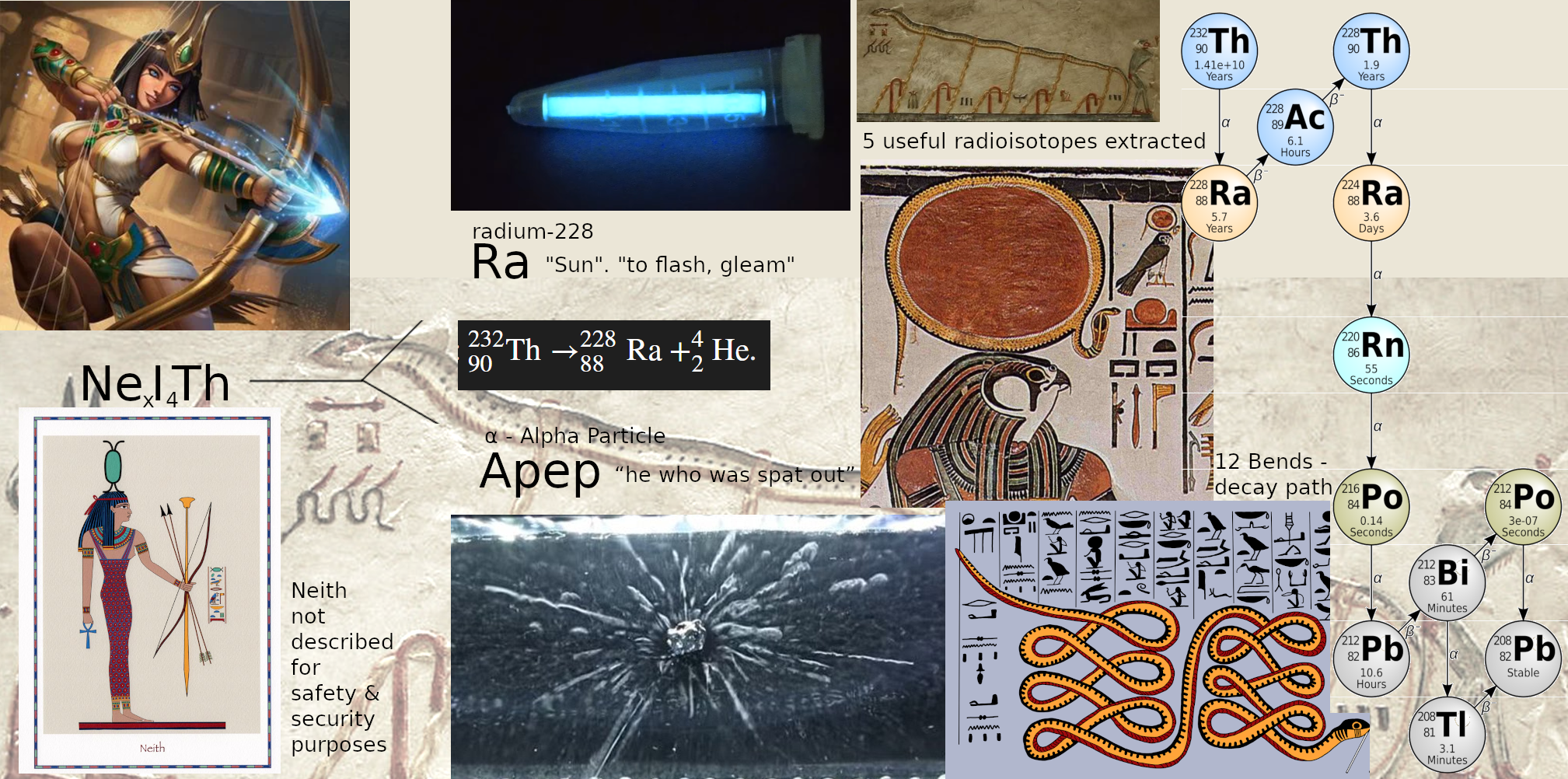
Apep surrounding Ra: Alpha particles continuously emitted by the radioactive source
Etymology: Apep/Apophis = Alpha Particles
The name Apep (ꜥꜣpp, "Aapep") and its Greek form Apophis (Ἄποφις) encode the term "alpha" with remarkable precision. The etymology reveals deeper meaning:
- "Apep" → "A(lpha) P(article) E(mitted) P(rojectile)"
- "Apophis" → "Apo-" (Greek: away from, off) + "-phis" (φύω, phyo: to grow, to spring forth)
- Literally: "That which springs away from [the source]" = nuclear emission
- Egyptian epithet: "He Who Was Spat Out" = alpha particles ejected from atomic nuclei
Apep Surrounds Ra: Continuous Alpha Emission
Egyptian mythology consistently depicts Apep as coiling around or attempting to swallow Ra's solar barque. This is not metaphorical—it encodes the physical reality that alpha particles radiate outward from the radium source (Ra) in all directions:
"Apep rises from the depths of the Duat, his coils surrounding the barque of Ra. The serpent is vast beyond measure, encircling the sun god in darkness..."
— Book of Gates, Fifth Division
Physical correspondences:
- Serpent coils: Helical tracks of alpha particles in cloud chambers
- Surrounding the barque: Omnidirectional radiation from a point source
- "Vast beyond measure": The immense number of alpha particles emitted per second (millions to billions depending on activity)
- "Rising from the depths": Particles emerging from deep within the atomic nucleus
- "Voice that roars": Ionization cascade and Geiger counter clicks
The 12 States of Swallowing: The Decay Chain Mapped
The mythology describes Apep's attempts to swallow Ra during the twelve hours of the night journey. Each "swallowing" represents an isotope consuming an alpha particle during decay, transforming into the next element in the chain. The twelve states correspond to the thorium-232 decay series:
The 12 States/Bends of Apep (What He Has Swallowed):
Hour 1: Thorium-232 → α emission → Radium-228 (5.75y)
Hour 2: Radium-228 → β⁻ emission → Actinium-228 (6.15h)
Hour 3: Actinium-228 → β⁻ emission → Thorium-228 (1.9y)
Hour 4: Thorium-228 → α emission → Radium-224 (3.6d)
Hour 5: Radium-224 → α emission → Radon-220 (55s)
Hour 6: Radon-220 → α emission → Polonium-216 (0.15s)
Hour 7: Polonium-216 → α emission → Lead-212 (10.6h)
Hour 8: Lead-212 → β⁻ emission → Bismuth-212 (60.6m)
Hour 9: Bismuth-212 → α emission (64%) OR β⁻ (36%) → Thallium-208/Polonium-212
Hour 10: Polonium-212 → α emission → Lead-208 (stable)
Hour 11: Lead-208 (stable end) - Ra reaches the "gate of the horizon"
Hour 12: Transformation/Rebirth - Ra emerges as Khepri at dawn
Each "hour" represents a nuclear transformation. The "swallowing" metaphor describes how the parent isotope is consumed by the decay process, emitting Apep (alpha particles) and transforming into a daughter isotope. The branching at Hour 9 (Bismuth-212's dual decay modes) corresponds to mythological descriptions of Apep taking multiple forms or having different heads.
The 12-Branched Tree That Must Be Cut Out
Egyptian funerary texts describe priests performing rituals to "cut the serpent into pieces" and extract a "twelve-branched tree" from within Apep's body. This encodes advanced radiochemical knowledge:
"Let Apep be cut with knives, let his spine be broken in twelve places, that the tree of life may be extracted from his coils and the souls of the righteous may pass..."
— Book of Overthrowing Apep
The twelve-branched tree is the decay chain diagram itself—the branching pathways of radioactive transformations that must be mapped and understood to safely handle the decay products. "Cutting out the tree" represents:
- Separation of individual isotopes from the decay chain
- Chemical extraction and isolation of specific decay products
- Understanding and documenting the complete decay sequence
- Neutralization or containment of each stage of the decay process
The 5 Extraction Points: Usable Radioisotopes
Within the decay chain, there are five primary points where isotopes can be chemically extracted for practical use. These correspond to mythological descriptions of Apep having "five heads" or "five coils" that must be bound:
The 5 Extraction Points:
- Radium-228 (Hour 2) - Long half-life (5.75y), beta emitter, useful for calibration sources and medical applications. Mythologically: Ra himself, extracted via Neith's Ne(x)I4Th compound
- Thorium-228 (Hour 4) - Intermediate half-life (1.9y), alpha emitter, parent of the Radium-224 → Radon-220 chain used in targeted alpha therapy. Mythologically: Thoth (THorium), the scribe who records the hours
- Radium-224 (Hour 5) - Short half-life (3.6d), alpha emitter, used in cancer treatment and as a generator for Radon-220. Mythologically: Amun-Ra - "The Hidden Ra" (224 vs 228, lighter isotope, hidden/diminished mass), approaching the deepest part of Duat
- Radon-220 (Hour 6) - Very short half-life (55s), gaseous alpha emitter, penetrates deeply, used for targeted radiation therapy. Mythologically: The "breath of Apep," the poisonous gas that fills the Duat
- Lead-212/Bismuth-212 (Hours 8-9) - Used in nuclear medicine, particularly Bismuth-212 for alpha therapy targeting cancer cells. Mythologically: The final guardians before the gate to dawn, must be appeased or overcome
Priests performing the "Ritual of Overthrowing Apep" were following a radiochemical separation protocol. The ritual described:
- "Drawing Apep with red ink": Mapping the decay chain diagram
- "Spitting upon Apep": Using aqueous chemical solutions for separation
- "Binding the five coils": Isolating the five key extraction points
- "Cutting with flint knives": Physical/chemical separation techniques
- "Burning Apep with fire": Thermal treatment to drive off volatile components (especially Radon-220)
- "Enclosing in a box": Lead shielding and containment
Why Apep Can Never Be Permanently Destroyed
A central theological principle of Egyptian mythology is that Apep can never be permanently killed—he must be defeated nightly, but always returns. This encodes a fundamental truth of nuclear physics: radioactive decay is inevitable and continuous.
As long as Ra (Radium-228) exists, he must emit Apep (alpha particles). The decay process cannot be stopped or prevented—only managed, shielded, and directed. Set's nightly battle represents:
- Radiation shielding: Lead barriers, distance, and time protocols
- Active monitoring: Detection and measurement of radiation levels
- Directional control: Collimation and focusing of radiation for useful purposes
- Waste management: Safe disposal or storage of decay products
The mythology teaches that attempting to permanently destroy Apep would mean the end of Ra himself—because radioactive decay is the source of Ra's power and light. The goal is not elimination, but balance and control.
"He Who Was Spat Out": Nuclear Ejection
The epithet "He Who Was Spat Out" (ꜥꜣpp ḫr-ḥꜣ) perfectly describes alpha emission at the quantum level. An alpha particle (2 protons + 2 neutrons, a helium-4 nucleus) is ejected/spat out from the parent nucleus through quantum tunneling, traveling at approximately 5% the speed of light.
The violent, explosive imagery associated with Apep—roaring, thrashing, causing earthquakes—matches the energetic nature of alpha decay, which releases 4-9 MeV of energy per decay event. The alpha particle's path through matter causes intense ionization damage, which the Egyptians described as Apep's "poisonous bite" or "corrupting touch".
Archaeological and Ritual Evidence
- Apep Ritual Papyri: Detailed instructions for "defeating Apep" match radiochemical separation procedures
- Wax Figurines of Apep: Created and symbolically destroyed in temples—may represent training models for decay chain manipulation
- The Serpent's "Twelve Bends": Consistently described in funerary texts, matching the 12-step decay sequence
- Red Ink Drawings: Apep drawn in red ink then defaced—red representing both danger and the color of certain radium compounds
- Daily Temple Rituals: Priests performed Apep-overthrowing rituals at specific times (dawn, noon, dusk, midnight), corresponding to radiation safety protocols at different times of radiochemical operations
The Dendera Crypt Relief: Visual Proof of Extraction Technology
Perhaps the most compelling archaeological evidence is the relief from Crypt No. 4 at the Dendera Temple complex, which depicts what appears to be a radiochemical containment and extraction apparatus:
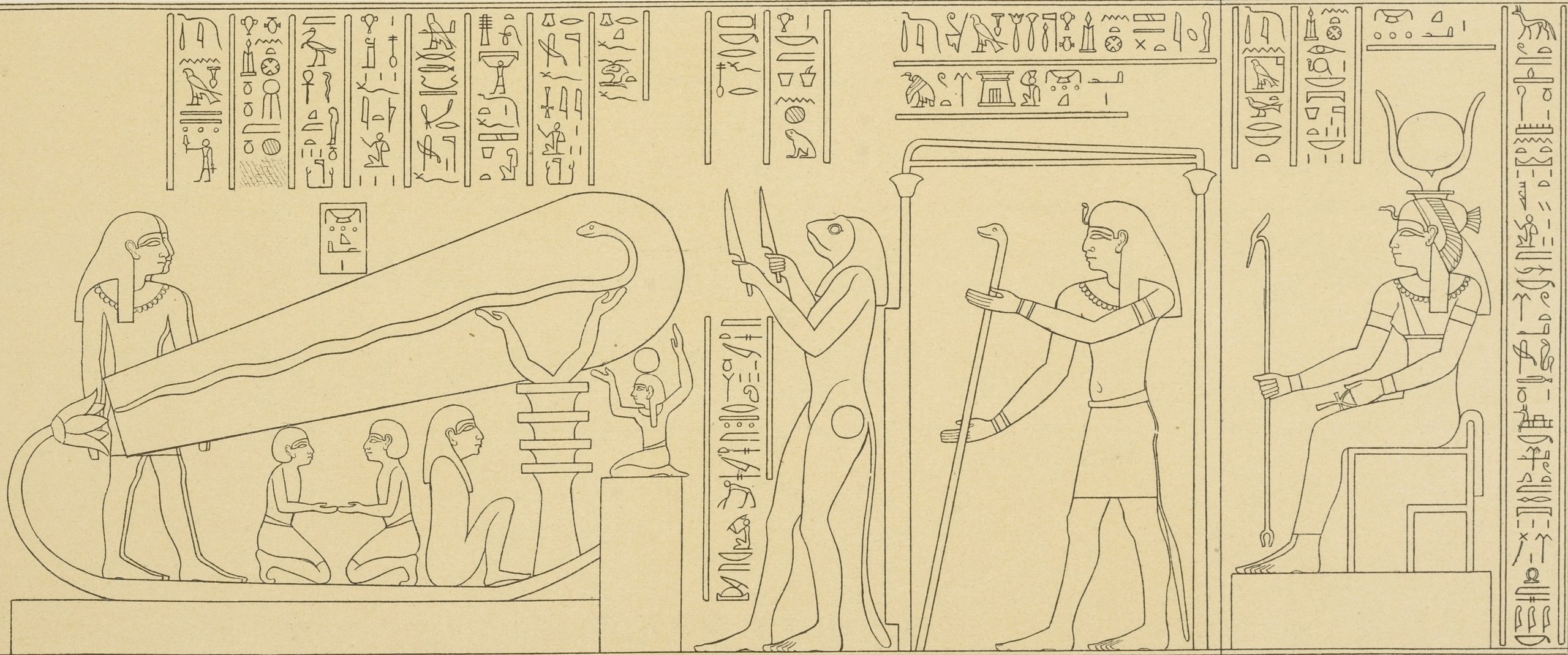
Dendera Temple, Crypt No. 4: A serpent (Apep/alpha radiation) contained within a bulbous chamber supported by a lotus pillar, with priests performing extraction operations
Key elements visible in the relief:
- Large bulbous vessel/chamber: Glass or transparent containment vessel, similar to a cloud chamber or radiochemical reactor vessel. The elongated bulb shape is ideal for:
- Visualizing alpha particle tracks (cloud chamber function)
- Containing gaseous decay products (Radon-220)
- Providing safe observation distance from radioactive source
- Allowing precipitation and separation processes
- Serpent inside the bulb: Apep contained within the vessel - representing alpha particles/radiation being confined and controlled. The serpent's position suggests it is suspended in the medium, not free-floating, consistent with a radioactive source in solution or suspension.
- Lotus flower base: The lotus emerges from a base and supports the entire apparatus, suggesting:
- The extraction medium (lotus = blue lotus, possibly encoding chemical reagents)
- Water-based chemistry (lotus grows in water)
- The Neith connection (lotus associated with creation from primordial waters)
- Djed pillar support: The djed pillar (symbol of stability, backbone of Osiris) supports the bulb chamber, representing:
- Structural support for heavy glass/ceramic vessel
- Shielding column (possibly lead-lined or dense material)
- Stability required for precision chemical operations
- Priests with knives/tools: Multiple figures manipulating the apparatus with implements that resemble:
- Chemical separation tools (stirrers, extraction rods)
- Ritual "defeat of Apep" = safe handling protocols
- Collection or sampling instruments
- Small figures below the chamber: Appear to be tending to or monitoring the base/support system, suggesting:
- Temperature regulation (heating/cooling)
- Monitoring of extraction process
- Collection of products at the base
- Seated deity (right side): Hathor or Isis overseeing the process, representing:
- Supervisory role of senior priest/scientist
- Magical protection during dangerous operations
- Record-keeping and documentation
- Standing deities with staffs: Protective deities flanking the apparatus, similar to radiation safety officers or guardians preventing unauthorized access to dangerous materials
Interpretation: Cloud Chamber, Extraction Vessel, or Radium Light Source?
The Dendera relief can be interpreted in three complementary ways:
1. Cloud Chamber Visualization:
- The bulbous chamber contains supersaturated vapor (alcohol or water vapor)
- The serpent represents visible alpha particle tracks appearing as ionization trails
- This would allow priests to see the radiation (Apep made visible)
- The serpentine form perfectly matches the characteristic helical/wavy tracks of alpha particles in cloud chambers
- Ancient Egyptians could have observed: "The serpent appears when Ra is present, and vanishes when he is removed"
2. Radiochemical Extraction Vessel:
- The chamber contains aqueous solution with thorium ore or radium-bearing material
- The serpent represents the radioactive source suspended in extraction medium
- The bulb shape allows for precipitation, separation, and collection of isotopes
- The lotus base suggests the Ne(x)I4Th compound or other reagents entering from below
- Priests extract the five key isotopes (five heads/coils of Apep) at different stages
3. Radium Serpent Light Source (Most Literal Interpretation):
- The serpent itself is made of radium—a physical object shaped like a snake and containing concentrated radium salts
- The serpent glows with blue-green radioluminescence in the darkness of the crypt, providing illumination
- This would literally be a "serpent of light" or "glowing Apep" visible to observers
- The bulbous vessel provides containment and shielding while allowing the light to be visible
- This interpretation explains why it's depicted so prominently and why it's in a sealed crypt (radiation containment)
Could a Physical Radium Serpent Work as a Light Source?
Yes, technically feasible but extremely dangerous:
How it would work:
- Physical construction: A serpent-shaped object made from or coated with radium-zinc sulfide paint (similar to early 20th-century luminous paint)
- Radium particles mixed with zinc sulfide phosphor
- Alpha particles from radium decay excite the phosphor, producing visible light
- Would glow continuously without external power for years
- Blue-green color characteristic of radium luminescence
- Required radium concentration:
- Early radium paint: ~1-2 mg radium per gram of paint
- A 1-meter serpent statue might contain 100-500 mg total radium (0.1-0.5 grams)
- This would provide visible glow in complete darkness
- Brightness: comparable to dim LED or glow-in-the-dark paint, but permanent
- Visibility and light output:
- In complete darkness (underground crypt), would be clearly visible as glowing serpent outline
- Not bright enough for reading or detailed work, but sufficient for ritual/ceremonial purposes
- The glow would be eerie, otherworldly—perfect for representing chaos/danger
- Would appear to "move" or "writhe" as viewer's eyes adjust and perception shifts (pareidolia effect)
The deadly danger (why containment is essential):
- Alpha radiation hazard:
- 100-500 mg radium produces ~3.7-18.5 GBq (100-500 mCi) activity
- Extremely hazardous if approached or touched
- Alpha particles have short range in air (~5-8 cm), but cause severe damage if inhaled or ingested
- External exposure: relatively safe at distance >1 meter if contained in glass
- Radon-220 gas production:
- Radium-224 decays to gaseous Radon-220 (55-second half-life)
- Radon accumulates in sealed chamber
- If chamber leaks or is opened: lethal radon exposure to anyone nearby
- "The breath of Apep" = radon gas escaping = deadly
- Contamination risk:
- Radium paint flakes or dust = internal contamination if inhaled
- Radium-226 (if present) accumulates in bones, causing cancer and anemia
- Handling without gloves = absorption through skin
- Gamma radiation:
- Decay products (especially Lead-212, Bismuth-212) emit gamma rays
- Penetrates glass and human tissue
- Chronic exposure at close range (hours per day) = radiation sickness, increased cancer risk
Containment solutions (why the bulb design is brilliant):
- Glass bulb:
- Blocks alpha particles completely (they cannot penetrate even thin glass)
- Allows visible light through (radioluminescence visible to observers)
- Contains radon gas if properly sealed
- Provides physical barrier preventing touch/contamination
- Distance from observers:
- Mounted on tall pillar keeps source 2-3 meters from ground level
- Gamma radiation follows inverse-square law: doubling distance = 1/4 the dose
- At 3 meters: relatively safe for brief ritual observations
- Underground crypt location:
- Earth and stone provide additional gamma shielding
- Restricted access prevents unauthorized exposure
- Controlled ventilation allows radon to dissipate safely
- Cool temperature prolongs chemical stability
- Djed pillar = lead shielding?
- The djed pillar supporting the bulb may contain lead or dense stone
- Directional shielding: protects workers below while allowing viewing from sides
- "Backbone of Osiris" = the structural support that makes safe use possible
Historical parallels (this was actually done in the 20th century):
- Radium Girls (1917-1926): Watch dial painters used radium paint for luminous dials
- Radium-zinc sulfide paint applied to watch hands and numbers
- Glowed brightly enough to read in darkness
- Workers suffered horrific radiation poisoning from ingestion (licking brushes)
- Same technology could create glowing serpent, same deadly risks
- Early 1900s radium novelties:
- Radium-painted toys, jewelry, decorations sold commercially
- Advertised as "magical glowing objects"
- Later recognized as catastrophically dangerous
- Ancient Egyptians may have created similar objects with full knowledge of danger
Would Egyptians have known it was deadly?
Yes, absolutely:
- The entire Apep mythology is built around danger, chaos, and death
- "He who was spat out" = understanding that radiation emanates from the source
- "Must be contained but never destroyed" = cannot eliminate radioactivity, only shield it
- Placement in sealed crypt with restricted access = radiation safety protocol
- Priests who handled radium would have observed:
- Burns on skin from handling (acute radiation dermatitis)
- Illness after prolonged exposure (radiation sickness)
- Death of workers who had close contact (cancer, organ failure)
- The mythology IS the safety manual: "Defeat Apep nightly" = daily safety protocols, "Set must spear the serpent" = maintain containment and shielding
Most likely scenario: The Dendera bulb served all three functions simultaneously:
- Light source: Physical radium-painted serpent glowing blue-green in darkness
- Extraction vessel: Lower portion contains liquid extraction medium for radiochemical processing
- Cloud chamber: Upper portion vapor space shows alpha tracks when viewed carefully
This triple function would make it a masterwork of ancient nuclear engineering: a self-illuminating radioactive source that also serves as visualization and processing equipment, all contained within a brilliant shielding design that allows observation while minimizing exposure.
The Dendera "Light Bulb" Controversy Resolved
Modern pseudoarchaeology has labeled this relief the "Dendera Light Bulb," claiming it depicts ancient electrical technology. The radioisotope interpretation provides a scientifically coherent explanation:
- Why it glows: Radioluminescence from concentrated radium, not electricity
- Why serpent-shaped: Alpha particle tracks or the radioactive source itself, not a filament
- Why supported on pillar: Structural and shielding requirements, not an insulator
- Why priests use tools: Chemical manipulation and safety protocols, not electrical wiring
- Why in a crypt: Shielding from radiation, temperature control, and secrecy of advanced knowledge
The relief depicts real technology—not anachronistic electricity, but sophisticated radiochemistry and nuclear physics that would not be "rediscovered" in the West until the late 19th and early 20th centuries.
The Naqa Lion Temple: The 12 Bends Made Visible
At the Lion Temple of Apedemak in Naqa (Sudan, Meroitic period), a remarkable serpent relief provides direct visual confirmation of the 12-state decay chain:
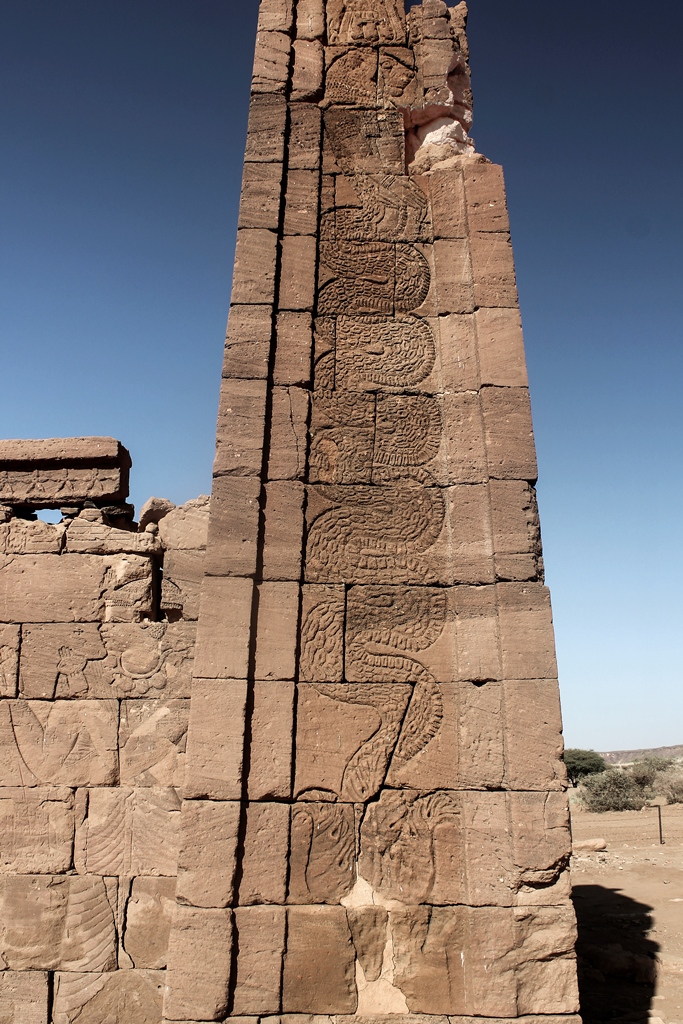
Lion Temple of Apedemak, Naqa: Serpent displaying segmented coils representing the 12 transformations of the decay chain
Visible features confirming the 12-bend theory:
- Distinct segmented coils: The serpent's body shows clear divisions/segments as it ascends the pillar, representing the discrete isotope transformations
- Vertical ascent: The serpent climbs upward along the pillar, possibly representing:
- Radon-220 gas rising through the extraction column
- The decay chain "ascending" from heavy isotopes (bottom) to lighter ones (top)
- Thermal convection in the extraction apparatus
- Flower/lotus elements at base: Botanical imagery at the foundation, connecting to:
- The lotus pillar in the Dendera relief
- The chemical extraction medium (lotus = reagent symbolism)
- Neith's association with lotus and weaving/extraction from waters
- Regular, repeated pattern: Each bend/coil is similar in size and spacing, suggesting the systematic, predictable nature of radioactive decay steps
- Integration with architecture: The serpent is not decorative but integral to the pillar structure, suggesting it represents a functional understanding of the decay process as foundational knowledge
The Lotus/Flower Symbolism: Chemical Extraction Medium
Throughout Egyptian iconography, the blue lotus (Nymphaea caerulea) appears in association with Ra, creation, and rebirth. This botanical symbolism encodes sophisticated chemistry:
The Blue Lotus as Chemical Metaphor:
- Opens at sunrise, closes at sunset: pH-dependent or temperature-dependent chemical reactions that proceed in cycles
- Extraction processes that occur optimally at specific times of day
- Temperature-sensitive precipitation reactions
- The daily solar cycle mirroring extraction/concentration cycles
- Grows from muddy water to pristine flower: The purification metaphor
- Extracting pure radium (Ra) from thorium-bearing mud/ore
- Separation of isotopes from mixed "primordial waters" (solution)
- Transformation from chaos (Nun/muddy sediment) to order (purified radium)
- Blue color: Matches radium's characteristic blue-green radioluminescence
- Radium salts emit blue-green glow in darkness
- The lotus's blue petals encode the visual signature of successful extraction
- "Blue lotus opens at dawn" = radium glowing when Ra (sun/radium) is present
- Psychoactive alkaloids: The lotus contains apomorphine and nuciferine, which cause:
- Altered states of consciousness (used in religious rituals)
- Protection against radiation sickness? (speculative: alkaloids as radioprotective compounds)
- Enhanced perception for observing subtle phenomena (alpha tracks in cloud chambers)
The Lotus in Extraction Chemistry:
- Lotus = Neith's extraction medium: The Ne(x)I4Th compound may have been called "lotus water" or "lotus tears"
- Aqueous solution containing neodymium, iodine, and thorium reagents
- "Weaving Ra from the waters" = chemical extraction using lotus (reagent) medium
- The lotus pillar in Dendera = the column through which extraction medium flows
- Lotus emergence from Nun: Represents precipitation of radium from solution
- Nun (primordial waters) = aqueous extraction solution
- Benben stone/lotus = precipitated radium salt crystals
- "Ra emerges on the lotus at dawn" = radium crystals form and glow
- The Thousand-Petaled Lotus: Some texts describe the lotus with many petals, possibly representing:
- Multiple extraction stages or fractions
- The branching decay pathways (especially at Bismuth-212 split)
- The complexity of separating isotopes from a mixed source
Mythological Lotus References Decoded:
- "Nefertum, the blue lotus at the nose of Ra":
- Nefertum = The extraction process or reagent
- "At the nose of Ra" = Gaseous products (Radon-220, "breath of Apep")
- The lotus produces the volatile/gaseous fraction that emanates from Ra
- "Ra born from the golden lotus":
- Golden = the color of radium salts or the glow they produce
- "Born from" = chemically extracted from the lotus medium
- Creation myth = extraction protocol
- "Lotus pillars in temples":
- Architectural representation of extraction columns
- The capital (flower) at the top = where purified product emerges
- The shaft = the separation column
- The base = where raw material enters
- "Offerings of lotus to Ra":
- Ritual = replenishing extraction reagents
- Fresh lotus = fresh chemical supplies for continued extraction
- "Ra is pleased by lotus offerings" = the extraction process requires the reagent to function
The Naqa Relief Shows Both Elements:
The Naqa Lion Temple serpent relief beautifully integrates both key symbols:
- Serpent (Apep): The radioactive decay chain with its 12 distinct transformations
- Flower/lotus base: The chemical extraction medium from which the decay products are separated
- Vertical pillar: The extraction/separation column or the containment vessel
- Integration of all three: The complete radiochemical extraction system encoded in a single architectural element
This shows that the knowledge was widespread across Egyptian and Nubian territories, and remained consistent over centuries—the serpent always has its characteristic bends/transformations, and it always emerges from or is associated with the lotus/flower extraction medium.
Iconographic Evidence Supporting Chemical Theory
Temple reliefs, tomb paintings, and ritual papyri provide extensive visual documentation of Apep's role in the radioisotope decay process. Three interconnected iconographic themes confirm the alpha particle interpretation:
1. The Serpent's Twelve Coils and Twelve Heads
Egyptian iconography consistently depicts Apep with specific structural features that encode the 12-state decay chain:
- Twelve Heads Above the Serpent (Tomb of Ramesses VI): The most explicit visual evidence
- The serpent's body is shown with twelve distinct heads painted above it
- Each head represents a "soul swallowed" by Apep during the night journey
- Direct visual representation: 12 heads = 12 transformation states of the Th-232 decay chain
- The heads are aligned sequentially along the serpent's length, showing temporal progression
- Tightly Compressed Coils and Pleated Body: Structural encoding
- Apep shown with compressed, tightly wound coils (not loose or relaxed)
- Pleated or undulating body pattern = wave-like nature of particle emissions
- Compression = high energy density of alpha particles
- Each coil/pleat represents an emission event or decay state
- Segmentation and Divisions: Visual markers of discrete states
- Serpent's body often divided into distinct segments (Naqa relief, various tomb paintings)
- Segments = discrete isotope transformations, not continuous process
- Markings or bands separating segments = energy barriers between states
- "Twelve Bends" in Funerary Texts: Textual confirmation of visual motif
- "The serpent of twelve bends must be subdued" (Book of Overthrowing Apep)
- "His spine broken in twelve places" (ritual instructions)
- Twelve = consistent across textual and visual sources
Sources: Tomb of Ramesses VI (Valley of the Kings), Book of Gates reliefs, Lion Temple of Apedemak (Naqa, Sudan), Apep ritual papyri (multiple New Kingdom examples), temple battle scenes at Edfu and Dendera
2. Coils as "Sandbanks" Trapping Ra's Boat
Underworld journey texts and accompanying illustrations depict Apep's coils as physical obstacles that trap or impede Ra's solar barque, encoding the concept of energy barriers in radioactive decay:
- Sandbank Imagery: Apep described and shown as "sandbanks" blocking passage
- "The barque of Ra runs aground on the sandbanks of Apep" (Amduat, Hour 7)
- Visual: serpent coils depicted beneath or around the boat, forming barriers
- Sandbanks = activation energy barriers between decay states
- Ra cannot proceed until the barrier is overcome (energy threshold met)
- Sequential Barriers: Each coil must be passed in order
- Ra's barque must navigate through all twelve coils/sandbanks sequentially
- Cannot skip or bypass any coil = cannot skip decay states
- Each coil requires specific "magical words" or ceremonies to pass = specific decay conditions
- Visual depictions show boat advancing through coils one by one
- Coils as Energy Thresholds: Physical interpretation
- Each sandbank/coil = minimum energy required for transformation
- Ra must "gather strength" or receive "offerings" to pass = accumulation of decay energy
- Helpers push or pull the boat = catalysis or energy input to overcome barrier
- Once past barrier, boat moves freely to next obstacle = spontaneous decay after threshold
- Varying Difficulty: Some coils easier than others
- Texts describe some sandbanks as "shallow" (easy to pass) vs. "deep" (difficult)
- Corresponds to varying half-lives: some isotopes decay quickly (shallow), others slowly (deep)
- Visual: coils shown with different thickness or density = varying barrier heights
Sources: Amduat (especially Hours 6-8 where Apep's obstacles are most prominent), Book of Gates, Coffin Texts describing navigation of underworld obstacles, temple reliefs showing Ra's barque navigating serpent coils
3. Spearing and Slicing: Decay and Transformation
The most common Apep iconography shows the serpent being attacked, cut, or destroyed by deities (Set, Ra, or other defenders). This violent imagery encodes the physics of radioactive decay and alpha emission:
- Set Spearing Apep: The archetypal battle scene
- Set shown standing in Ra's boat, spearing Apep with a lance
- Spear penetrates serpent's body = alpha particle emission from nucleus
- Lance as projectile weapon = alpha particle as high-energy projectile
- Set as defender = shielding and radiation safety protocols
- Slicing with Knives: Ritual and physical cutting
- Priests shown cutting Apep with flint knives (ritual papyri)
- Serpent's body divided into pieces = separation of decay chain into individual isotopes
- Each cut = a decay event that transforms parent to daughter isotope
- Flint (silicon dioxide) = chemical reagent or filtering medium?
- Body Destroyed but Reforms: The cyclical nature
- Apep is killed, cut into pieces, burned, trampled—yet returns next night intact
- Perfect encoding: radioactive decay is continuous and inevitable
- Parent isotope destroyed (emits alpha) → daughter isotope created → daughter decays → next generation
- Apep's reformation = new alpha particles continuously generated from radioactive source
- Multiple Attackers: Different deities attacking different sections
- Some reliefs show multiple gods attacking Apep simultaneously at different coils
- Represents branching decay pathways (especially Bismuth-212's dual decay modes)
- Different attackers = different decay mechanisms (alpha vs. beta emission)
- Parallel attacks = competing or simultaneous decay routes
- Restraining Rather Than Destroying: Control over elimination
- Many scenes show Apep being bound, netted, or held—not killed
- Ropes or nets wrapped around coils = containment and shielding
- Goal is control, not destruction (which is impossible)
- Binding the "five coils" specifically = isolating the five extraction points
Sources: Temple of Edfu (extensive Apep battle scenes), Book of Overthrowing Apep (ritual papyri with illustrations), Tomb of Inherkhau (Deir el-Medina, vivid Apep spearing scene), Dendera Temple reliefs, Apep wax figurines used in rituals (archaeological finds from various temples)
Cross-Validation with Ra's Journey Iconography
The interconnection between Ra and Apep iconography provides complete visual documentation of the nuclear decay process:
- Synchronized Depictions: Ra's journey scenes always include Apep
- Where Ra appears in underworld (Amduat, Book of Gates), Apep is present
- The two are inseparable = radioactive source (Ra) intrinsically produces emissions (Apep)
- Visual confirmation: Ra cannot exist without Apep
- Twelve-Hour Structure: Both follow same temporal framework
- Ra's journey: twelve hours/divisions (see Ra's iconographic evidence)
- Apep's swallowing: twelve states/heads/coils
- Perfect correspondence: 12 = 12 = Th-232 decay chain with 12 transformations
- Spatial Relationship: Apep surrounds Ra
- Depictions show Apep coiled around or beneath Ra's barque
- Ra at center, Apep encircling = point source radiating alpha particles omnidirectionally
- Apep never shown separate from Ra during night journey = emission and source are coupled
- Progressive Weakening/Strengthening: Inverse relationship
- As Ra grows weaker (aging through night), Apep grows stronger/larger
- As decay progresses, parent isotope depletes while decay products accumulate
- Near dawn, Ra begins to glow and strengthen, Apep begins to weaken
- Completion of decay chain: Ra reborn (Lead-208 stable), Apep defeated (no more alpha emission)
Red Ink and the Color of Danger
Ritual instructions consistently specify that Apep must be drawn in red ink before being symbolically destroyed. This color choice encodes both warning and chemical properties:
- Red = Danger/Chaos: Universal warning color in Egyptian iconography
- Red associated with Set, violence, desert, danger
- Red ink for Apep = this is hazardous, handle with extreme caution
- Radiation warning encoded in ritual color choice
- Red Radium Compounds: Chemical observation
- Some radium salts (radium bromide, radium iodide) appear reddish or orange
- Oxidized radium compounds can have red-brown coloration
- Red ink may directly represent the color of certain radium/thorium compounds
- Ritual Sequence: Draw → Deface → Destroy
- Draw Apep in red ink (map the decay chain)
- Deface by crossing out or stabbing the drawing (neutralization ritual)
- Burn the papyrus (thermal treatment, disposal of contaminated materials)
- Complete protocol for handling radioactive materials encoded in religious ritual
Sources: Book of Overthrowing Apep (multiple papyri with instructions specifying red ink), ritual instructions from Ptolemaic period temples, priest training manuals describing Apep rituals
Conclusion: Apep the Alpha Emission
Apep is not merely a mythological monster—he is the encoded knowledge of alpha particle radiation, specifically the alpha emissions from the thorium-232 decay series that includes Radium-228 (Ra). The mythology teaches:
- Alpha particles are continuously emitted from radioactive sources (Apep surrounds Ra)
- The decay chain has 12 major transformations (12 hours/states of swallowing)
- Five key isotopes can be extracted for use (5 extraction points/heads/coils)
- The decay sequence must be mapped and understood (cutting out the 12-branched tree)
- Radiation cannot be eliminated, only controlled (Apep returns nightly but is defeated)
- Alpha particles are dangerous but necessary (Apep is chaos, but part of Ra's nature)
⚠️ Safety Note: Specific technical details of the extraction process using the NexI4Th compound have been deliberately omitted from this analysis due to the extreme radiological hazards associated with radium extraction and handling. These isotopes emit dangerous alpha and beta radiation, and radium-228 and its decay products present severe health risks including radiation poisoning, cancer, and bone damage. This information is withheld for public safety reasons, not because the techniques are unknown or "lost."
Cross-references: See Ra's theory for the Radium-228 identification and decay chain details, and Neith's theory for the radiochemical extraction process framework.
🔗 Related Deity Theories
Apep as Alpha Particles's theory is interconnected with several other deities in the thorium-232 decay chain and extraction framework:
Decay Chain Position:
12-Hour Journey (Decay Chain):
Hour 1: Th-232 → Hour 2: ⬤ Ra-228 → Hour 3: Ac-228 →
Hour 4: Th-228 (Thoth) → Hour 5: Ra-224 (Amun-Ra) → Hour 6: Rn-220 →
Hours 7-10: Po-216 → Pb-212 → Bi-212 → Pb-208 (stable)
⬤ = Alpha emission points (Apep manifests)