This section contains original research, interpretations, and theoretical frameworks developed by the author.
These ideas represent scholarly analysis and synthesis of Amun Ra's role within Egyptian mythology and comparative mythology.
Amun-Ra as Radium-224: "The Hidden Ra"
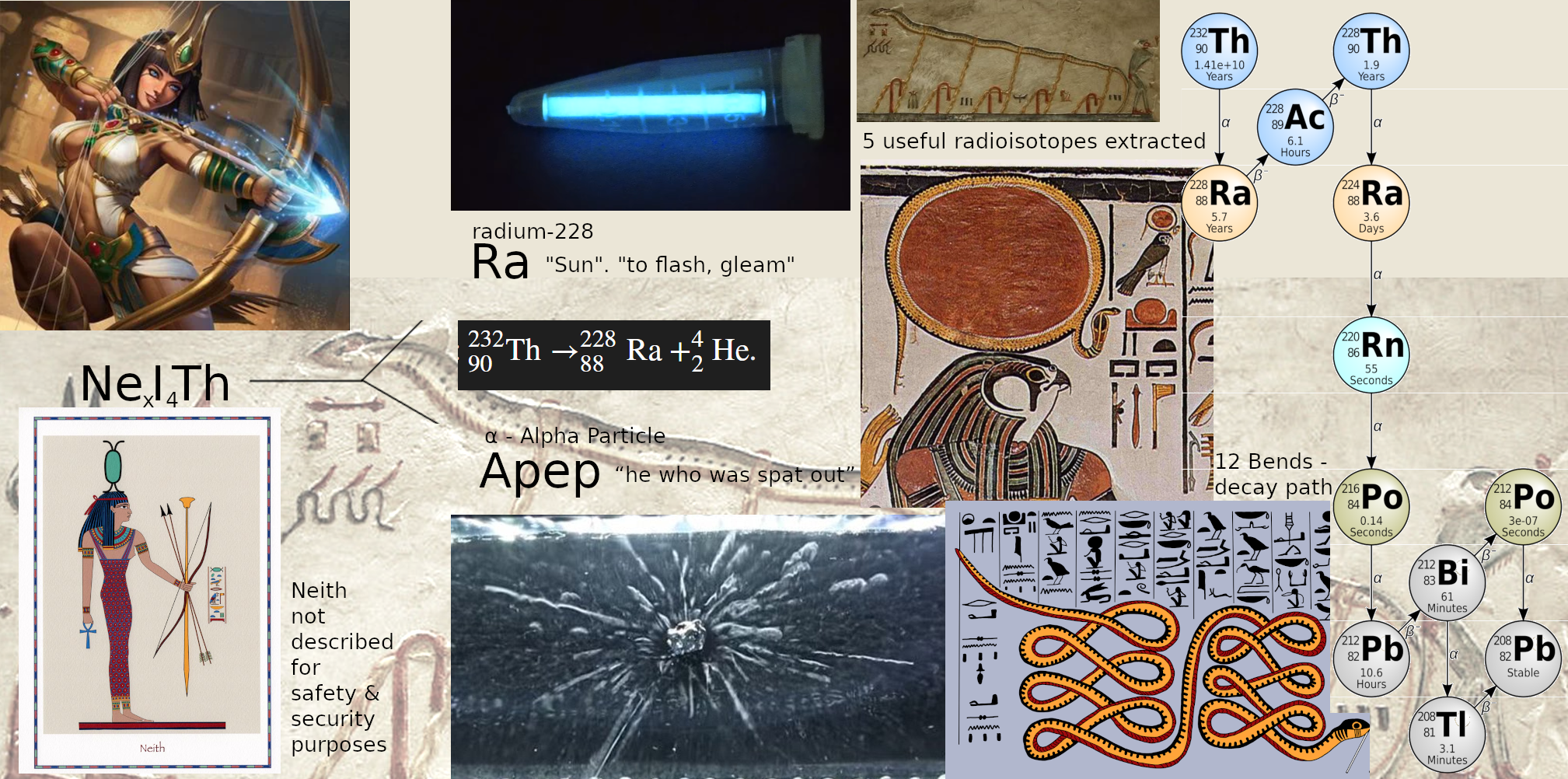
Amun-Ra represents Radium-224, the lighter "hidden" isotope of Ra in the decay chain
The Hidden Isotope: Radium-224
The syncretic deity Amun-Ra combines two seemingly paradoxical concepts: Amun ("The Hidden One," the invisible, transcendent force) with Ra (the visible, radiant sun god). This theological fusion encodes precise radiochemical knowledge: Amun-Ra is Radium-224 (²²⁴Ra), the lighter isotope of radium that appears later in the decay chain.
Why "Hidden"? The Diminished Mass
The epithet "The Hidden One" reveals the key distinction between the two radium isotopes:
- Ra (Radium-228): Mass number 228 - the primary, manifest form of Ra extracted by Neith
- Amun-Ra (Radium-224): Mass number 224 - **4 mass units lighter** (4 nucleons "hidden" or lost)
- The "hidden" aspect = reduced/diminished mass compared to the original Ra-228
- Still radium (still Ra), but in a concealed, transformed state (Amun)
Position in the Decay Chain: Hour 5 of the Duat
Amun-Ra appears at a critical point in Ra's journey through the Duat. In the thorium-232 decay series:
The Path from Ra to Amun-Ra:
Hour 1: Thorium-232 → α → Radium-228 (5.75y) [Ra - The Manifest Sun]
Hour 2: Radium-228 → β⁻ → Actinium-228 (6.15h)
Hour 3: Actinium-228 → β⁻ → Thorium-228 (1.9y) [Thoth]
Hour 4: Thorium-228 → α → Radium-224 (3.6d) [Amun-Ra - The Hidden Ra]
Hour 5: Radium-224 → α → Radon-220 (55s) [Breath of Apep]
Radium-228 (Ra) undergoes transformations through Actinium and Thorium, then **re-emerges as Radium-224** (Amun-Ra). The same element (radium/Ra) returns, but in a "hidden" form—lighter, faster-decaying, approaching the deepest and most dangerous part of the Duat where it will transform into the gaseous Radon-220 (the "breath of Apep").
The Short Half-Life: Rapid Transformation
Amun-Ra's theological prominence during the New Kingdom coincides with understanding of Radium-224's unique properties:
- Half-life of 3.6 days: Extremely rapid compared to Ra-228's 5.75 years
- "Hidden" because fleeting: Transforms quickly, difficult to observe or isolate
- Intense alpha emitter: Despite shorter lifespan, produces concentrated radiation
- Medical applications: Used in modern targeted alpha therapy (TAT) for cancer treatment due to its short half-life and alpha emissions
The Theological Synthesis: Visible and Invisible
Egyptian theology describes Amun-Ra as possessing both manifest and hidden aspects:
"Amun, whose name is hidden, whose form is Ra... You are hidden in your name as Amun, you are visible in your form as Ra."
— Hymn to Amun-Ra, Papyrus Leiden I 350
This describes the radiochemical paradox:
- "Hidden in name": Radium-224's reduced mass (hidden/lost 4 nucleons)
- "Visible in form": Still radium (Ra), still glowing, still emitting alpha particles
- "Amun" (hidden): The isotopic identity—224 vs 228, detectable only through nuclear analysis
- "Ra" (visible): The elemental identity—still radium, same electron configuration, same chemical behavior
Karnak Temple: The Amun-Ra Extraction Center
The vast Karnak temple complex, center of Amun-Ra worship during the New Kingdom (1550-1077 BCE), may have been a radiochemical processing facility specifically for extracting and utilizing Radium-224:
- Multiple processing chambers: The numerous halls and sanctuaries could represent different stages of isotope separation
- Sacred Lake: Water reservoir for radiochemical processes (co-precipitation, washing, cooling)
- The "Holy of Holies": Lead-shielded chamber containing concentrated Radium-224 sources
- Daily rituals at specific times: Timed extraction and measurement protocols matching Radium-224's 3.6-day half-life
- Priests with specialized knowledge: Radiochemists who understood the decay chain and extraction points
The Rise of Amun-Ra: New Kingdom Innovation
The elevation of Amun-Ra to supreme deity during the New Kingdom (rather than Ra alone) suggests technological advancement:
- Earlier dynasties: Extraction of Radium-228 (Ra) from thorium ores using Neith's Ne(x)I4Th compound
- New Kingdom innovation: Discovery of how to isolate Radium-224 (Amun-Ra) from the decay chain mid-sequence
- Therapeutic applications: Radium-224's properties (short half-life, intense alpha emission) made it superior for medical/ritual use
- "Hidden" knowledge: The technique for extracting Hour 5 of the decay chain required advanced understanding
Amun-Ra and the Opet Festival
The annual Opet Festival, where Amun-Ra's statue traveled from Karnak to Luxor Temple, may encode a radiochemical transport and renewal ritual:
- Annual renewal: Radium-224's 3.6-day half-life means sources needed frequent replacement
- Processional journey: Careful transport of radioactive material in lead-lined barque
- Rejuvenation of the god: Replacing decayed Radium-224 with freshly extracted material
- Timing: The festival occurred during the Nile flood season—perhaps when new thorium-bearing sediments arrived for processing
The King as Son of Amun-Ra
New Kingdom pharaohs claimed divine descent from Amun-Ra, not just Ra. This political theology encodes radiochemical lineage:
- "Son of Ra" (older title): Authority derived from Ra/Radium-228 knowledge
- "Son of Amun-Ra" (New Kingdom): Authority derived from advanced knowledge of Radium-224 extraction
- Divine conception myths: The pharaoh's mother receives Amun-Ra = access to the hidden radioisotope
- Legitimacy through knowledge: Only those who understood the "hidden" isotope could claim true kingship
Comparison: Ra vs Amun-Ra
| Aspect |
Ra (Radium-228) |
Amun-Ra (Radium-224) |
| Mass Number |
228 (heavier) |
224 (4 units lighter - "hidden") |
| Half-Life |
5.75 years (long-lasting) |
3.6 days (rapid, fleeting) |
| Position |
Hour 2 (early in Duat journey) |
Hour 5 (deep in Duat, approaching danger) |
| Extraction |
Direct from thorium ores (Neith's compound) |
From decay chain mid-sequence (advanced technique) |
| Theological Era |
Old Kingdom (Heliopolis) |
New Kingdom (Thebes/Karnak) |
| Symbolism |
Manifest, visible solar power |
Hidden nature within visible form |
Conclusion: The Hidden Radium
Amun-Ra represents advanced radiochemical knowledge from the New Kingdom period. The fusion of "The Hidden One" (Amun) with the Sun God (Ra) encodes:
- Radium-224: The lighter isotope (224 vs 228 - "hidden" mass)
- Extraction Point 3: Third of the five usable radioisotopes in the decay chain
- Hour 5 of Duat: Appears after Ra-228 undergoes multiple transformations
- Rapid decay: 3.6-day half-life (fleeting, "hidden" because it quickly transforms)
- Intense alpha emitter: Powerful despite diminished mass, used in targeted therapy
- Technological advancement: Represents mastery of mid-chain isotope extraction, not just initial separation
Cross-references: See Ra's theory for Radium-228 and the complete decay chain, Apep's theory for the 12 states and 5 extraction points, and Neith's theory for the radiochemical extraction process.
Alternative Theory: AMUN = Am-U-N (without Ra)
This alternative interpretation considers Amun alone (without Ra) as a distinct chemical compound, separate from the Amun-Ra/Radium-224 theory described above.
Distinguishing AMUN from AMUN-RA
- AMUN-RA: Radium-224 (²²⁴Ra) - the "hidden Ra" isotope in the decay chain
- AMUN (alone): Americium Uranium Nitride (AmUN) - a theoretical mixed actinide compound
- The presence of "Ra" in the name indicates the radium isotope; Amun without Ra suggests a different chemical identity
Etymology: Am-U-N
The name AMUN can be parsed as elemental abbreviations:
A-M-U-N →
Am = Americium (element 95)
U = Uranium (element 92)
N = Nitrogen (element 7)
Chemical Formula: AmUN (Americium Uranium Nitride)
Chemical Properties of AmUN
Americium Uranium Nitride would be a mixed actinide nitride with remarkable properties:
- Extremely dense: Both americium (13.67 g/cm³) and uranium (19.1 g/cm³) are among the densest elements
- Highly radioactive: Americium-241 (α emitter, 432 years) combined with various uranium isotopes
- High melting point: Actinide nitrides are refractory ceramics (melting points above 2500°C)
- Nuclear fuel material: Mixed actinide nitrides are studied as advanced nuclear fuel due to high heavy metal density
- Chemically stable: Nitrides of actinides form stable, crystalline compounds resistant to oxidation
Mythological Encoding
This interpretation reveals different aspects of Amun's mythology:
- "The Hidden One": Nuclear fuel buried deep underground or concealed in shielded chambers
- Primordial power: Heavy actinides (Am, U) represent the densest, most concentrated matter—the foundation of creation
- Invisible force: Radioactive emissions invisible to the eye, yet possessing immense energy
- Combined power: Two actinides together (Am + U) = doubled heavy element potency, "hidden" synergistic effects
- Creator deity: Nuclear reactions as the ultimate creative force, fission/fusion as cosmic generation
- Self-sustaining: Like Amun's self-created nature, nuclear materials generate their own energy
Technical Context: Mixed Actinide Fuels
Modern nuclear chemistry validates the theoretical soundness of AmUN:
- Uranium nitride (UN): Well-characterized high-density nuclear fuel with excellent thermal properties
- Mixed actinide nitrides: (U,Pu)N and similar compounds studied for Generation IV reactors
- Americium in fuel: Am-241 accumulates in spent fuel; some advanced fuel cycles propose using it deliberately
- High heavy metal density: Nitride fuels achieve higher actinide density than oxide fuels
- Thermal conductivity: Better heat transfer than oxide fuels, improving reactor safety
Why Nitrogen?
The nitrogen component is critical to this interpretation:
- Atmospheric connection: Nitrogen makes up 78% of Earth's atmosphere—the "air of Amun" or "breath of the hidden one"
- Life element: Nitrogen is essential for all proteins and DNA—Amun as creator of life through the fundamental building blocks
- Stabilizing agent: Nitrogen stabilizes the heavy actinides, preventing oxidation and decay
- Inert yet essential: Like Amun (hidden but omnipresent), nitrogen is colorless, odorless, non-reactive in elemental form, yet absolutely necessary
Comparison: Two Interpretations of Amun
| Aspect |
Amun-Ra (Ra-224) |
Amun Alone (AmUN) |
| Elements |
Ra (Radium) |
Am (Americium), U (Uranium), N (Nitrogen) |
| Chemical Identity |
Radium-224 isotope |
Mixed actinide nitride compound |
| "Hidden" Meaning |
Reduced mass (224 vs 228) |
Buried nuclear fuel, invisible radiation |
| Half-Life |
3.6 days (fleeting) |
Am-241: 432 years; U-238: 4.5 billion years (extremely long-lived) |
| Application |
Medical therapy (targeted alpha) |
Nuclear fuel, power generation |
| Symbolism |
Transformation in decay chain |
Primordial creative power, foundation of matter |
Americium & Uranium: Real-World Applications
Both constituent elements of AmUN have significant modern applications that reflect their "hidden yet essential" nature:
- Americium in Smoke Detectors: Am-241 serves as the ionization source in most household smoke detectors worldwide. This mirrors Amun's role as "The Hidden One"—an invisible alpha-emitting source present in virtually every home, silently protecting inhabitants without their awareness of its nuclear nature.
- Uranium in Nuclear Energy: Uranium powers nuclear reactors globally, providing electricity to millions. U-235 fission generates immense energy from tiny amounts of fuel.
- Uranium in Defense: Naval reactors (submarines, aircraft carriers) and weapons applications utilize uranium's concentrated energy density.
- Alpha Emitters: Both americium and uranium primarily decay via alpha emission, releasing heavy, energetic particles that can ionize air or trigger nuclear reactions.
- Symbolism of Hidden Protection: Just as smoke detectors contain hidden Am-241 protecting every dwelling, Amun was the "Hidden One" present in every temple, watching over creation. The parallel is striking: a radioactive "hidden god" in miniature form, safeguarding modern homes.
- Omnipresence Through Concealment: Americium's ubiquity in smoke detectors (estimated hundreds of millions worldwide) exemplifies Amun's theological omnipresence—invisible, yet everywhere, silently fulfilling its protective function.
Compound Symbolism: Hidden Power
The theoretical AmUN compound encapsulates profound symbolism about concealed, primordial energy:
- Highly Theoretical Nature: While uranium nitride (UN) is well-studied, mixed americium-uranium nitride (AmUN) remains largely theoretical, discussed primarily in advanced nuclear fuel research. Its very existence is "hidden" in possibility rather than confirmed reality.
- Dense Actinide Ceramic: AmUN would be an extraordinarily dense material, combining two of the heaviest elements (Am: 13.67 g/cm³, U: 19.1 g/cm³) in a refractory ceramic matrix capable of withstanding extreme conditions.
- Dual Fissile/Radioactive Power: Both americium and uranium are fissile actinides capable of sustaining nuclear chain reactions. AmUN represents the fusion of two independent sources of nuclear power—doubled primordial energy.
- Hidden Energy Release: The compound would continuously release energy through radioactive decay (alpha, beta, gamma emissions), invisible to human senses yet measurable and immensely powerful. This mirrors Amun as the unseen energetic source powering all creation.
- Advanced Nuclear Fuel: Actinide nitride ceramics are studied for next-generation reactors due to superior thermal properties and higher heavy metal density than oxide fuels. AmUN represents cutting-edge, "hidden" nuclear technology.
- Invisible Omnipresence: Just as Am-241 hides invisibly in smoke detectors throughout civilization, Amun was conceived as the invisible force permeating all existence—formless, hidden, yet absolutely fundamental to reality's structure.
- Raw Primordial Force: The combination of uranium (natural, primordial element present since Earth's formation) and americium (synthetic transuranic element) in nitride form symbolizes both ancient and modern understanding of matter's deepest, most energetic foundation.
- Doubled Nuclear Potency: U + Am together = two actinides, two alpha decay chains, two sources of fission power. This doubling reflects Amun's role as the supreme creator deity—not singular but compound, containing multiple aspects of generative force within one hidden identity.
Inter-Deity Chemical Reactivity
As a mixed actinide nitride (AmUN), Amun exhibits distinct chemical reactivity patterns with other deity-compounds. The two actinides (Am, U) combined with nitrogen create a compound that is stable under normal conditions but highly reactive when exposed to halogens or other aggressive oxidizing agents.
Reactivity Matrix: AmUN Interactions
| Deity (Compound) |
Reactivity Level |
Interaction Mechanism |
| Anubis (Au₃NPU) |
High |
N-N interaction potentially explosive |
| Osiris (OsIrI₄S₂) |
Low |
Dense metals resist actinides |
| Isis (SiI₄) |
Medium |
Iodine attacks nitrogen bonds |
| Thoth (ThO₂) |
Low |
Ceramic oxide resists nitride |
| Tefnut (UF₆) |
High |
Actinide-actinide, fluorine attacks nitride |
| Satis (ISAt) |
High |
Halogens oxidize nitrogen and actinides |
Hidden Reactivity: The Power Beneath
The reactivity patterns of AmUN perfectly embody Amun's mythological role as "The Hidden One" whose true power reveals itself only under specific conditions:
- Dual Actinide Core: AmUN contains two actinides (Am, U), both radioactive and energetically dense. This represents Amun's hidden reservoir of primordial energy—always present, always potent, but not immediately visible.
- Nitrogen Vulnerability: The nitrogen bonds holding the compound together are susceptible to halogen attack (F, I, Cl). The compound appears stable, but contains a structural weakness that can be exploited by aggressive agents.
- Symbolism of Concealed Power: Amun appears stable and inert (like ThO₂ or other ceramic compounds), but beneath this stable exterior lies explosive potential. The "Hidden One" is not weak—merely dormant until provoked.
- High Reactivity with Volatile Deities: When AmUN encounters volatile, aggressive compounds (Tefnut's UF₆, Satis's ISAt, Anubis's Au₃NPU), the hidden power is revealed. Fluorine rips nitrogen away, halogens oxidize the actinides, and the dormant energy becomes manifest violence.
- Low Reactivity with Stable Deities: When AmUN interacts with stable, dense materials (Osiris's OsIrI₄S₂, Thoth's ThO₂), the hidden power remains concealed. The actinides stay bound in their nitride matrix, unreactive and quiet—but still present, still powerful.
Key Reactive Combinations
Amun vs. Tefnut → Americium Trifluoride (AmF₃)
Reaction:
AmUN + UF₆ → AmF₃ (americium trifluoride) + UNF₃ (complex)
Properties of AmF₃:
- Stable, highly radioactive solid (pink to tan crystalline powder)
- Exhibits radioluminescence - faint glow from self-irradiation (alpha particles exciting the crystal lattice)
- Melting point: ~1393°C (highly refractory)
- Used in research and potential advanced nuclear applications
Symbolism: The clash between Amun (primordial hidden power) and Tefnut (fierce volatility and transformation) creates a new, stable, energetic form. The resulting AmF₃'s radioluminescent glow represents the revelation of the Hidden God's power—energy that was concealed within AmUN now becomes visible as light.
Mythological Interpretation: When the hidden primordial force (Amun) meets fierce transformation and volatility (Tefnut), the hidden energy becomes manifest and visible. The radioluminescence is the symbolic "unveiling" of Amun—the hidden one made visible through chemical transformation. Yet AmF₃'s stability shows that even when revealed, Amun's power is not destroyed but channeled and contained in a new, stable form.
References:
Anubis vs. Amun → Gold Nitride (AuN)
This reaction is covered in detail on the Anubis page. Cross-reference for complete analysis of this extreme interaction.
Key Points:
- Extreme Instability: AuN (gold nitride) is one of the most unstable compounds known—explosive and highly sensitive to shock, heat, and friction
- Boundary Violation: The reaction between Anubis (guardian of death, Au₃NPU) and Amun (primordial creator, AmUN) represents a transgression of cosmic boundaries between death and creation
- N-N Interaction: Both compounds contain nitrogen, and their interaction can produce unstable nitrogen-nitrogen bonds leading to explosive decomposition
- Mythological Meaning: When the Hidden Creator meets the Guardian of Death, the result is catastrophic instability—a violation of the natural order that cannot be sustained
See the Anubis Inter-Deity Reactivity section for detailed chemical mechanisms and mythological implications.
References and Further Reading
Note: Both interpretations—Amun-Ra as Radium-224 and Amun as AmUN—may coexist within Egyptian theology. The syncretic nature of Egyptian religion often embraced multiple, complementary understandings of the same deity. Amun-Ra could represent both the isotopic transformation in the decay chain AND the primordial nuclear fuel material, depending on context and ritual purpose.